






Frequently Asked Questions
-
What is the difference between L, M and H class vacuums?
The classification relates primarily to the specification of the filter. L class filtration is suitable for Low hazard materials, M class for Medium hazard, H for High hazard. L class filters are required to have a leakage no greater than 1% of the collected dust, M class no greater than 0.1% and H class no greater than 0.005%. Put simply, a H class filter will block particles that would pass through an L or M class filter.
-
What class of vacuum do I need on a building site?
For construction works, general waste is considered Low hazard. Concrete and mortars are rated medium hazard as are some natural woods, notably beech and oak; engineered woods such as MDF are also Medium rated. Carcinogenic substances such as Asbestos are classed as High hazard.
-
Can I upgrade my L class vacuum by changing the filter type?
You may well be able to fit a higher specification filter to your basic vacuum but that will not change its classification and it could reduce its performance. In practical terms, M and H class filters have a finer weave (than L class) so as to block finer dust particles. But inevitably, this also constricts airflow. So M and H class vacuums have other features which compensate for this condition e.g. larger motors, pre-separation elements, integral filter cleaning. Put simply, there is much more to vacuum or dust extractor performance than the filter.
-
What are the three key considerations in selecting a dust extractor for construction work?
Product selection should mirror the end-to-end requirements of the work. Firstly, select a filter type that is suitable for the materials you are going to be dealing with. Secondly, consider the performance requirements of the work you are doing e.g. volume of dust and waste being collected, intensity of work, accessibility (determines hose length required). Thirdly, consider how the waste will be contained and disposed of. Effective dust control starts with capture of dust at the point of creation, ends with dust-free disposal of the waste and in between, ensures exhausted air from the vacuum system is devoid of harmful particles.
-
Why and when should I use an Interceptor with a Dust Extractor?
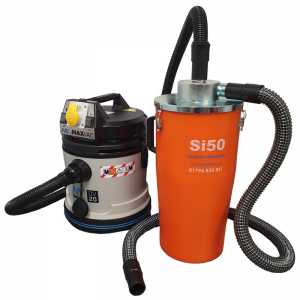
An interceptor will collect a large percentage of dust and debris ahead of the filtration stage in the attached vacuum device. This presents many benefits including maintenance of strong airflow and suction, longer filter cleaning intervals and most probably extended life of the attached vacuum.
An Interceptor can be deployed with any vacuum device so there is a wide range of situations where it is beneficial. Typically, it simplifies the collection and handling of waste products, complements a vacuum device that has low grade filtration or limited storage capacity, or in many situations, allows the vacuum device to be positioned away from the work area.
See also our FAQs on Interceptors